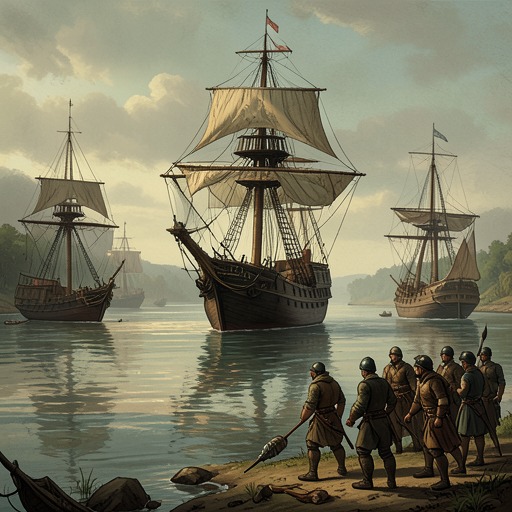
Xu Sheng’s defense against Cao Pi’s invasion
The Romance of the Three KingdomsXu Sheng’s defense against Cao Pi’s invasion of Wu is a story of military appearance defeating numerical strength. In AD 224, Cao Pi brings a formidable land and naval force against Wu, but Xu Sheng constructs an immense false wall along the Great River. When the fog lifts, the apparent scale of Wu’s defenses persuades Cao Pi to retreat; attacks during that withdrawal turn his campaign into a severe defeat.
Background and the invasion
The crisis follows the renewed alliance between Shu and Wu against Wei. Cao Pi rejects advice to wait and build up military resources, and instead orders preparations for an immediate invasion. By autumn AD 224, the expedition is ready: ten enormous dragon boats, each more than two hundred feet long and able to carry two thousand men, accompany three thousand warships. The combined land and naval forces number over three hundred thousand.
Wu prepares to meet the threat at the Great River. With Lu Xun defending Jingzhou, Sun Quan appoints Xu Sheng to take up a defensive position by the river. Xu Sheng volunteers eagerly for the task, which places him at the center of the response to Cao Pi’s immense force. The contrast is established early: Wei brings overwhelming numbers and imperial ceremony, while Wu’s defense depends on discipline, deception, and control of the river crossing.
Command and discipline in Wu
Xu Sheng’s command is tested not only by the enemy but by insubordination within his own camp. Sun Shao, Sun Quan’s nephew, repeatedly demands permission to cross the river with his three thousand men and attack the Wei forces. Xu Sheng refuses each time. His concern is that the army cannot preserve order if a subordinate persistently challenges a commander’s decisions during a crisis.
Xu Sheng orders Sun Shao’s execution as a warning, but Sun Quan arrives at the moment it is about to be carried out and demands a halt. Xu Sheng respectfully explains the danger of weakening military discipline. Sun Quan spares his nephew but permits Xu Sheng to dismiss him from the army. Sun Shao, angered by the rebuke, nevertheless crosses the river with his men. Xu Sheng responds by sending Ding Feng after him to keep watch. The episode exposes a tension within Wu’s defense: the king’s family ties restrain the commander’s authority, while Sun Shao’s defiance creates a further risk on the battlefield.
The false wall and Cao Pi’s retreat
Cao Pi arrives at Guangling aboard his great dragon boat, accompanied by Cao Zhen. When told that no enemy troops are visible on the opposite bank, he sails out to inspect the river himself. The barge displays the emblems of imperial rule, including the dragon and phoenix, sun, and moon. Cao Pi asks why the army should not cross, but Liu Ye counsels caution.
During the night, heavy fog hides the southern bank. Cao Pi is told that the absence of lights means Wu’s defenders have fled in fear. At sunrise, however, the fog lifts to reveal what appears to be an immense defensive wall stretching for roughly a hundred miles, guarded by a large army. The wall has been erected overnight on Xu Sheng’s orders, but it is a fabrication. Its purpose is to make an assault seem hopeless, and it succeeds: Cao Pi judges that his army cannot overcome the apparent numbers and skill of the defenders and decides against attacking.
The deception turns a potential contest of strength into a contest of judgment. Cao Pi has come to inspect the opposite bank, yet the sight before him offers no reliable measure of Wu’s actual forces. The false wall exploits that uncertainty, making the scale of the defense itself a weapon. A rising wind also threatens the imperial dragon boat, and Wen Ping intervenes to save Cao Pi from danger on the river.
Retreat, battle, and consequences
The decision to withdraw is compounded by a report that Zhao Zilong and his men have emerged from Yangping Pass and are moving toward Chang’an, Wei’s capital. Cao Pi orders the army to retreat along the river to protect it. During the withdrawal, Sun Shao attacks the Wei forces and nearly captures Cao Pi; the army loses half its men. As Cao Pi attempts to move from the water onto land, burning reeds soaked in oil block his route. Ding Feng attacks, and Cao Pi escapes only through the efforts of Zhang Liao and Xu Huang.
The defeat is immense, and Wu takes a great quantity of captured goods. Zhang Liao dies of his wounds, and Cao Pi provides him with a full military funeral. The retreat therefore ends not simply with the abandonment of the invasion but with substantial losses, captured spoils, and the death of a prominent Wei commander. Xu Sheng’s false wall has helped turn the appearance of an impregnable defense into the opening of a damaging withdrawal, while the attacks by Sun Shao and Ding Feng make that retreat costly.
Strategic significance
The episode brings together two contrasting kinds of military power. Cao Pi’s invasion is built around enormous numbers, a large fleet, and the visible symbols of imperial authority. Xu Sheng answers with a defensive image: an immense wall that conceals the real situation and makes the enemy hesitate. The strategy does not depend on the wall actually stopping an assault; it succeeds by persuading Cao Pi that an assault cannot succeed.
The outcome also shows that deception alone does not account for the scale of the defeat. Cao Pi’s retreat creates the opportunity for Sun Shao’s attack and for the later assault involving Ding Feng, while the alarm over Chang’an shapes the decision to withdraw. In this account, Xu Sheng’s stratagem is the decisive defensive device, but command tensions, battlefield initiative, and the need to safeguard Wei’s capital turn the retreat into a rout.